
Calcium Fluoride (CaF₂) Lens Processing Capabilities
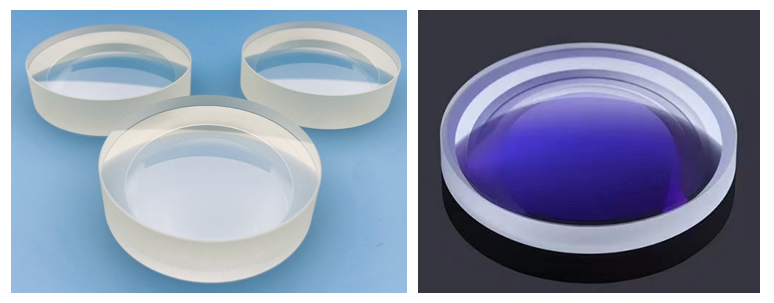
Calcium fluoride (CaF₂) is an important optical crystal material. Due to its ultra-wide transmission range from deep ultraviolet (DUV) to mid-infrared (MIR), it is widely used in the optical field. CaF₂ exhibits no significant intrinsic birefringence at wavelengths above 200 nm, making it suitable for high-precision polarization optical systems. With its optical properties of low dispersion and high laser damage threshold, as well as low absorption, it can withstand high-power laser irradiation. It is an ideal material for projection objectives and illumination windows in deep ultraviolet lithography systems, and is also an essential material for high-power ultraviolet lasers and excimer laser optics. Depending on the application, CaF₂ material is processed into optical components such as beam-splitting prisms, windows, and lenses.
Optical Properties of Calcium Fluoride
1. Transmission range: 0.13 μm (deep ultraviolet) to 9 μm (mid-infrared).
2. UV region (< 200 nm): transmittance exceeds 90%, superior to fused silica.
3. IR region (3–5 μm): transmittance > 95%, suitable for thermal imaging systems.
4. Refractive index: low and low dispersion (n = 1.43 @ 200 nm, n = 1.40 @ 5 μm), suitable for broadband anti-reflection coating design.
5. Absorption characteristics: UV-grade and VUV-grade calcium fluoride exhibits no significant absorption below 250 nm, making it suitable for optical components in ultraviolet laser cutting, marking, and other equipment, ensuring efficient laser energy transmission.
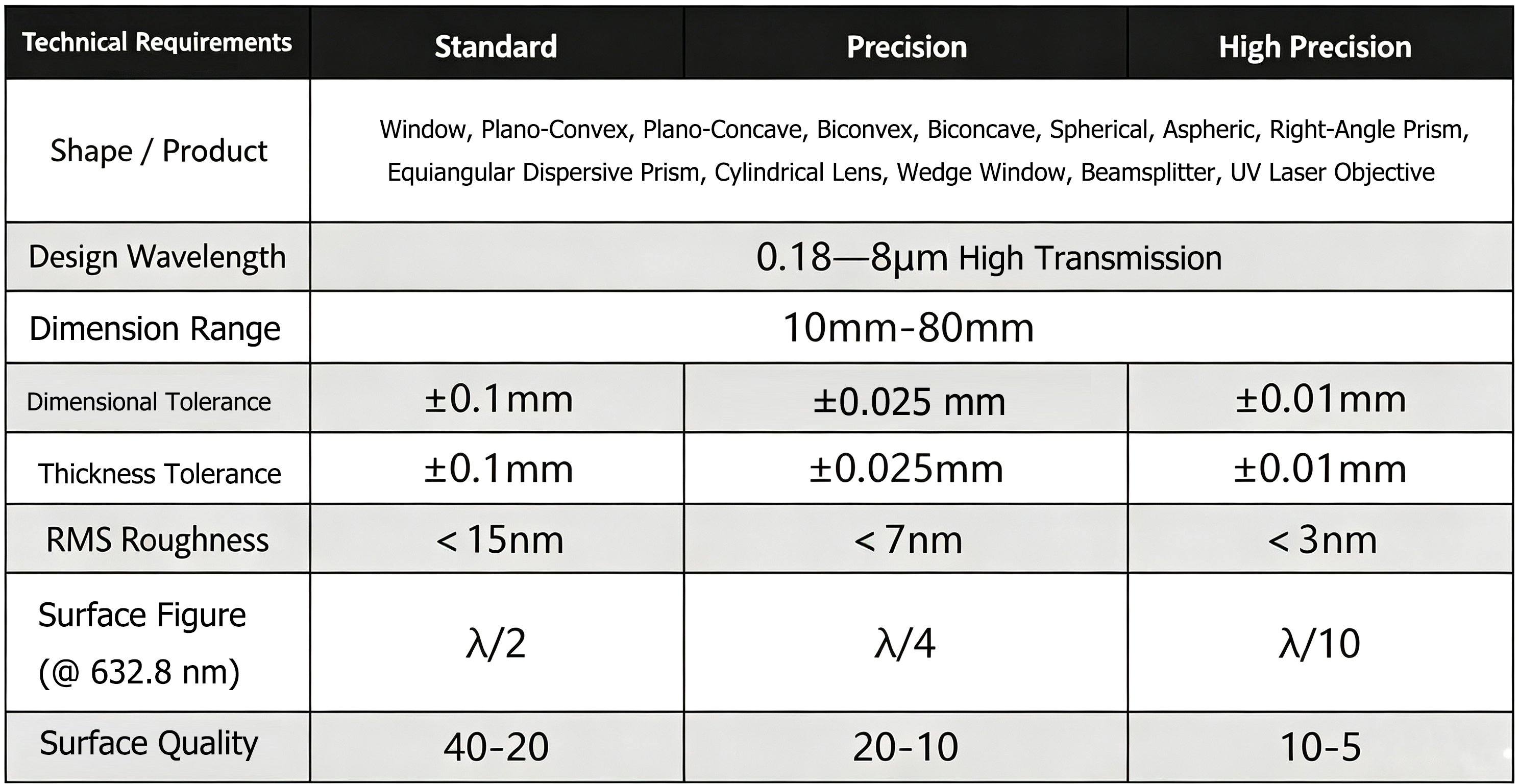
Calcium Fluoride Lens Processing Specifications
Applications of Calcium Fluoride Lenses
1. Deep Ultraviolet Lithography Systems
193 nm Lithography Machines: In semiconductor manufacturing, excimer-grade calcium fluoride is used in lithography objectives, combined with 193 nm excimer lasers to achieve nanometer-scale chip pattern exposure. The low absorption and high uniformity of CaF₂ ensure lithography resolution.
DUV Lasers: Used as output windows for excimer lasers (such as ArF, wavelength 193 nm), capable of withstanding high-frequency, high-intensity laser irradiation.
2. Infrared and Ultraviolet Imaging Systems
Infrared Thermal Imagers: IR-grade calcium fluoride lenses exhibit high transmittance in the 3–5 μm band, effectively focusing infrared radiation emitted by objects, aiding imaging at night or in harsh environments. They are widely used in security, reconnaissance, and other fields. Vacuum Ultraviolet Imaging: VUV-grade calcium fluoride can transmit vacuum ultraviolet light above 130 nm, and can be used in biological microscopic ultraviolet fluorescence detection and extreme ultraviolet imaging systems in space exploration.
3. Interferometers and Spectrometers
Interferometers: Utilizing the low dispersion and high uniformity of calcium fluoride, they are used to detect surface figure errors of optical components, ensuring the stability and accuracy of interference fringes.
Spectrophotometers: Calcium fluoride serves as prism and window material. Utilizing its high transmittance from ultraviolet to infrared, it ensures that light of different wavelengths can pass through accurately, improving analysis precision.
Post time: Sep-17-2026