
High-power fiber lasers are highly effective in metal cutting and welding. The focus spot quality of the cutting head directly affects cutting efficiency. Experienced technicians often judge focus performance indirectly by scribing metal plates or burn-marking photographic paper at defocus positions. However, this method is operator-dependent, non-quantitative, and wastes consumables.
CCD camera-based beam profilers capture the laser spot intensity distribution using a 2D array sensor, convert it into an image, and analyze it via software. They are the most widely used type, capable of measuring continuous, pulsed, and single-pulse lasers with real-time monitoring. However, the camera cannot withstand high-intensity laser irradiation. The beam must first be attenuated to the microwatt level before reaching the sensor, without saturating the detector.
Laser power attenuation typically uses three methods: neutral density (ND) filters, polarization attenuation, and coated optical mirrors. For high-power fiber lasers, absorptive attenuation is impractical, and since the beam is generally non-linearly polarized, polarization attenuation is also unsuitable. Coated optical mirror attenuation is essentially beam splitting—extracting a lower-energy reflected or transmitted beam for measurement.
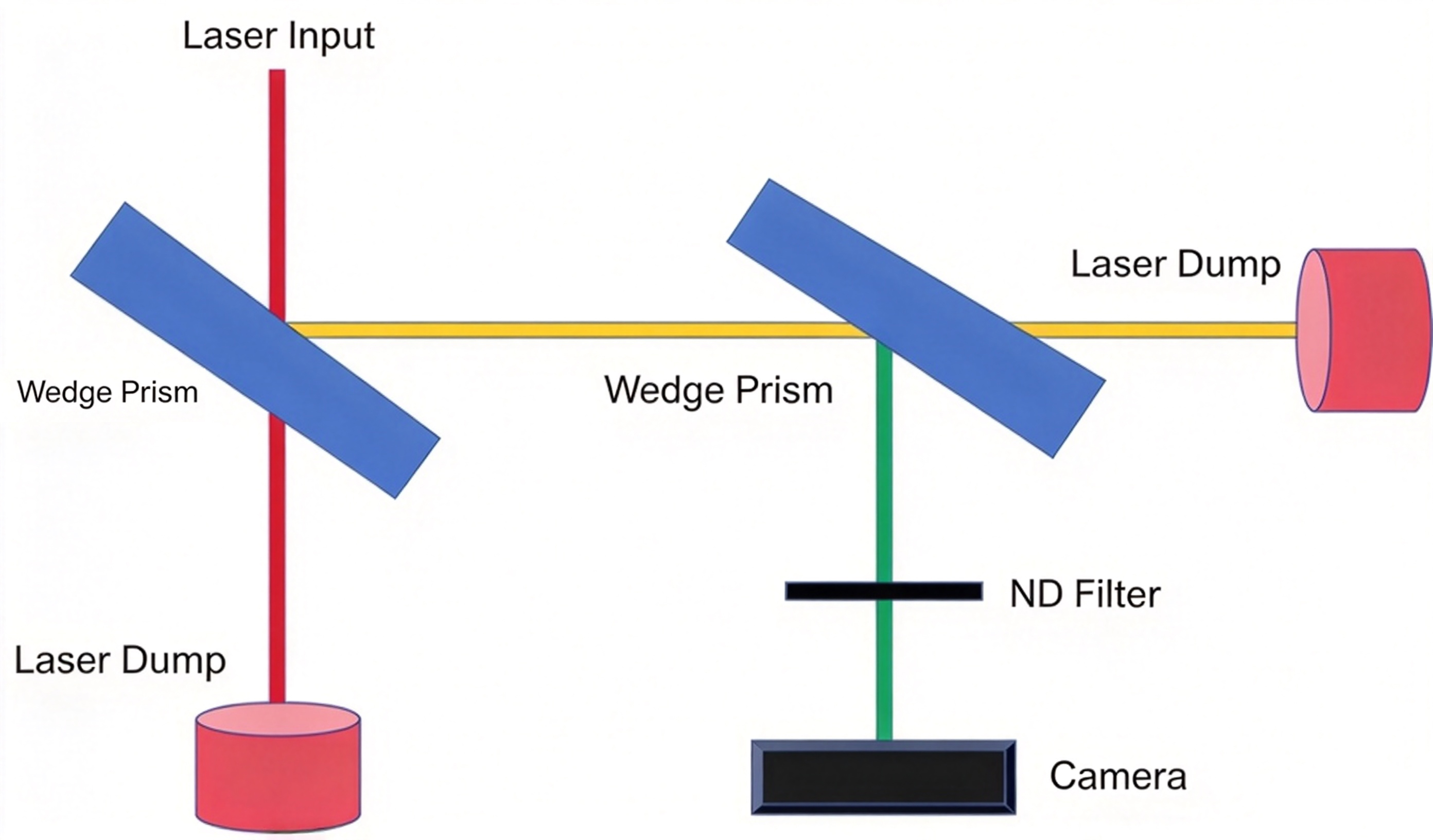
For fused silica glass, Fresnel equations give the average surface reflectance at any incidence angle, making it easy to determine how many reflections are needed to attenuate power to a detector-safe level. At 45° incidence, the average single-surface reflectance of fused silica is about 4.33%. For a 1000 W laser, two reflections reduce power below 2 W; three or more are needed to reach the milliwatt level. To avoid interference between front and rear surface reflection points, wedge prisms are typically used as attenuation mirrors.
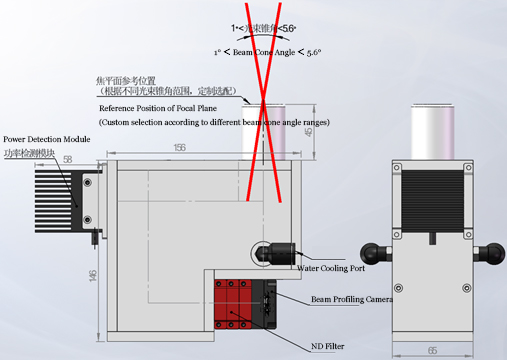
Based on this theory, a beam profiler can be developed for visual measurement of focus spot quality in high-power fiber laser cutting heads, directly withstanding 2000 W. Different incident distances can be customized according to the beam cone angle (NA) to be measured. Inside the module, besides the wedge prism attenuation assembly, a 4F optical conjugate imaging system transforms the focus spot image onto the camera sensor. Laser power can also be measured simultaneously, enabling a comprehensive evaluation of cutting head performance in one pass.
We can also develop beam analysis modules for directly measuring F-theta scan lens focus spot quality. This module contains only the wedge prism attenuation assembly, so it directly measures the actual focus spot quality—the beam focuses inside the module. This design is more compact and can simultaneously measure focus spot quality and incident laser power, providing an integrated evaluation and improving efficiency.
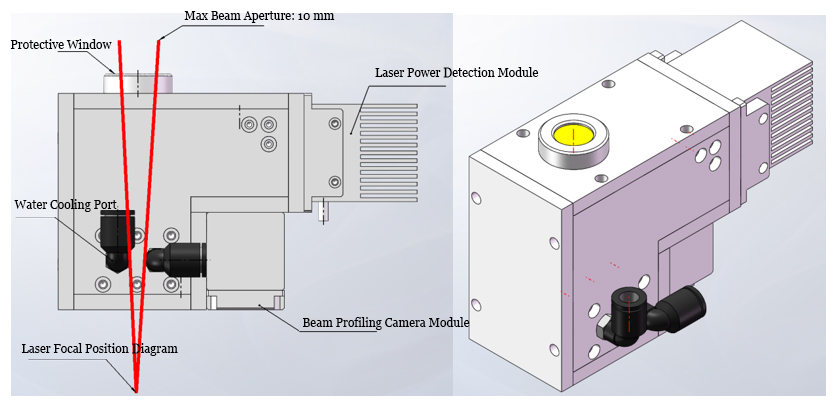
For other measurement methods, we welcome discussions on feasibility.
Product Features:
(1) Directly withstands/measures laser power up to 2000 W;
(2) Measures focus spot size >30 μm;
(3) Requires water cooling, flow rate >15 L/min;
(4) Supports simultaneous power measurement (proportionally attenuated);
(5) Long working distance focus measurement (scan lens) or short working distance focus measurement (cutting head);
Post time: Nov-12-2026